Showing posts with label shiva. Show all posts

Wednesday, December 6, 2017

Such Is Life

Sunset over Jerusalem.
The sun doesn't go down, it's the world that keeps on turning.
We live on the third floor of an apartment building. Directly below us on the second floor are a young family who just welcomed their third daughter into the world. And on the first floor, directly below them, are a couple in their late 50s with grown up children and baby grandchildren.

On DD's birthday, as we went downstairs to go to school in the morning, we noticed a big colourful poster on the door of the family on the second floor. WELCOME HOME TO MUMMY AND OUR BABY SISTER! We smiled and said that we must go in and visit next week and take a gift.

We left the building and outside in the parking area we saw a small marquee with the sign 'Sukkat Avelim'. It means 'Mourners' Shelter'. I looked to see where the electric cable from the roof of the marquee went into the building and saw that it was attached via the balcony of the couple on the first floor.

My heart sank as I understood what had happened. Although there were no notices up yet I had met the wife in the supermarket last week and she told me her son was in hospital. Had an elderly grandparent died, they would have not have needed a tent. But when a young man with a family of his own dies, there are more mourners and more friends who come to visit and comfort during the week of shiva.

By the time I got home from school and was rushing out to collect DD and her friends for the birthday supper, the notices were up. I had been right. Michael was was a young family man with four babies - two sets of twins all under four years old.

The funeral had been in the morning and the street around our building was full of tearful friends and family. My neighbour came out of the tent. I hugged her, "I'm so sorry, I'm so sorry," was all I could say. We all assumed he would be ok. He was young, there are babies, he was in the hospital, the hospital makes you better doesn't it?

I popped into their apartment on my way upstairs to say a few words to her husband and then ran up to dump my bag and do a quick change of clothes. On my way back out I met the new father on the second floor. I wished him Mazal Tov and we walked out together, through the mourners to the street.

He drove off to collect his wife and new baby from the hospital and I went to celebrate DD's birthday. Such is life.

Tuesday, January 17, 2017

One Year Of Mourning - Yarhzeit

Today we have our first Yarhzeit. This is the anniversary of the death of a parent (although it can be observed for any close relative or friend). There are various customs but the bottom line is that you light a memorial candle that burns for 24 hours, say the Kaddish prayer and keep the day sombre. (The references say refrain from eating meat or drinking wine. Seriously? I never do either of these in the middle of the week.)

The first Yarhzeit also marks the end of the year of official mourning which you observe only for your parents. (Otherwise people from big families could have years of mourning as they all get older.)

It's a funny old year. There are rules and customs and, it seems, in the end everyone does what they feel comfortable doing. The main customs are not to go to any parties or places of entertainment - defined as places where there is live music, not to wear any new clothes, and to say the Kaddish prayer three times a day with a minyan (a quorum of 10 Jewish men over the age of Bar Mitzva).

Many Jewish men do go to three services a day throughout their lives, Most don't. I remember my father going to a service once a day when he was saying Kaddish for his father. At the weekends he would go to our local shul (synagogue) for the morning service and when at work, he'd go to the afternoon service at the shul near his office in Great Portland Street, London.

I wanted to say Kaddish but it was not realistic to think I could get to a minyan even once a day. As a full-time working, single mother, without a car, I can't even commit to getting to the supermarket once a week. It is for this reason that women are actually exempt from saying Kaddish. Yes, that's right, we don't have to do it at all. But I, like many modern Jewish women, wanted to say it.

My sister in London, who has older children and a car, committed to saying Kaddish with a minyan once a day for the first 30 days (a period of more intense mourning). In the end she continued for the whole year as she said she found it comforting. I don't know what my brother did - I didn't ask and he didn't tell me.

I decided to say Kaddish on my own at home without a minyan for the whole year.  This decision was reinforced by two events that occurred at our shiva. The first was on the Sunday of the shiva. There was a discussion about whether we could get a minyan at the house for the afternoon service or whether my sister and brother would have to go to shul. We had five men in the house (brother, bro-in-law, and three teenage nephews), We had two visiting males and they were wondering if they should knock on the neighbour's door to ask him and his two sons to come and make up the numbers. At that moment I decided that even if I had the opportunity to say Kaddish with a minyan, I would not. I had no interest in giving significance to a minyan that I was not even considered a part of, to heighten my Kaddish. In fact, after that incident, I started leaving the room when they did services in the house in order to say my Kaddish in private.

A few days later my sister's rabbi was visiting and they were discussing how she was going to say Kaddish in the shul. He said, "you just have to make sure that someone is saying Kaddish."
I was confused. "What do you mean? She's saying Kaddish."
The rabbi turned to me and answered with a completely straight face, "as she is a woman, a man has to say the Kaddish with her. It can be another mourner or it can be any man who has previously lost a parent."
Gobsmacked is a word I could use here to describe my reaction. I kept my mouth shut however.
After the rabbi had left, other friends told me that not all other orthodox shuls hold by that rule and that it's entirely at the discretion of the individual rabbi in charge. My decision to not say Kaddish with a minyan was confirmed as the right decision for me.

Tomorrow I'll tell you about my Kaddish experience and explain what the prayer is. And later about how I avoided parties, live music and new clothes.


Saturday, January 16, 2016

The Shiva (Week Of Mourning)

I want to write about the shiva week but have no idea exactly what I want to say. You already know what shiva is from this previous post so I don't have to explain it. I'm just going to write and see what emerges.

Of course there are the usual shiva stereotypes as with any social gathering. I'm not going to describe the ones I spotted at our shiva as everyone came out of kindness and love and there's an awkwardness around death that can affect people's behaviour despite themselves. Having said that, no one came too early or stayed too late. No rabbis or other learned friends gave long or boring sermons.

My sister's community works like a well oiled machine with a big heart. The friend arranging a meal rota so that home cooked suppers were delivered every day for all nine of us, called to ask if she could also arrange lunches as too many people wanted to contribute.

The 'rules' of mourning are not rules but customs that have evolved into strong tradition. This means you get a lot of flexibility if you are the sort of person who is open to flexibility. I am and so is my mother.

The traditional meal on returning to the shiva house after the funeral is a hard boiled egg, a bagel (with optional butter) and some pickled or salted herring. I'm guessing here that the round foods symbolize the circle of life as does the fish (fish being a fertility symbol) and the pickled or salted aspect symbolizes your sadness and salty tears. I also assume that this was the traditional light lunch or breakfast in the shtetl and it stuck.

You are supposed to wear the same clothes every day and not to wash for a week. This can be interpreted as wearing the same item that was ripped at the funeral. Our ripped garments were cardigans and we wore them every day. My mother and I (and DD) returned to her flat every night where we showered and returned the next day with fresh clothes under the cardigan. I can't speak for the others, I didn't notice.

I also developed an obsession with washing my hands as so many people said, "I won't kiss you as I'm a bit fluey so I'll just shake hands."

There is a mourner's payer, the Kaddish, that the children say for their dead parent (or for themselves, I'm not quite sure), Traditionally only men said this prayer, three times a day for 11 months, in a minyan (a quorum of 10 men who pray together). Nowadays many women say it as well. My sister wanted to say it in a minyan. The the first opportunity for a service at home during the shiva was the afternoon service on Sunday. They started counting around for a minyan. We had five men over the age of Bar Mitzva in the house, they have a neighbour with two sons, and there were two male visitors. We women didn't count at all and were expected to stand at the back. At that point I decided I would be saying my Kaddish alone and not in any exclusively men's minyan. (Btw, there are many enlightened Jewish communities that run with complete egality of the sexes but my sister belongs to a more orthodox community.)

There were pleasant surprises when two friends from Israel turned up as they happened to be in London. An old boyfriend from when I was 17 and I hadn't seen since (although we are fb friends). Friends from my childhood, schooldays, youth club, college years... I have in the past not made it to a shiva, thinking no one would mind as plenty of others would be there and I'm not so close to the person anymore. I've re-thought this after sitting shiva myself. It's so wonderful to see your whole life pop up and come to comfort you. Along with cousins we hadn't seen in years - we found ourselves slipping back into the past and retelling it with warm nostalgia.

DD was taken out by various friends with younger children every day. She had a blast and somehow managed to come home each day with a present in hand. However, her biggest treat was when my b-i-l taught her how to do the washing up and allowed her to wash up whenever there was something in the sink. She said to me, "it's a shame we don't have something like this at home." She pointed to the dish drainer next to the sink. Me: "we do have something like that darling, I'll point it out to you when we get home."

What can I tell you, we had a good shiva.


Saturday, January 9, 2016

The Funeral

We were greeted at the funeral grounds by a lovely man, I think he was Irish, who explained to us what was going to happen and in what order. My sister had the official documents that had to be handed over and we also discussed how we would like to perform certain traditions that can be approached in different ways.

My cousin's wife had brought a small pair of scissors so we could make a cut and tear our clothes. It's a small tear on the left above your heart in one garment and you wear that item for the entire week.

The order of service is that we start in the prayer hall for some prayers and someone or someones, in this case my father's rabbi and my sister, speak about the deceased. Then, led by the chief mourners (us), everyone follows the casket down to the grave. Then we all come back to the prayer hall for more prayers and finally the mourners walk out first and greet (not sure that's the right word) all the friends and family as they come out. (This final bit was the option we chose above greeting everyone inside the hall on our way out as that takes ages and feels a bit undignified - like we're celebrities on a red carpet or the Royal Family doing a walkabout.)

I had removed myself emotionally from the whole purpose of the occasion right up until entering the prayer hall. I can do that. Better than falling apart all over the place in public. But then you walk in and see the coffin and think, my Daddy's in that box. I felt my eyes well up but I got it under control before any tears fell.

There were over 200 people at the funeral. Possibly more, I'm not very good at estimating crowds so it could have been more. Two of my closest friends from school came and stood right behind me. It was a real comfort that they were there. I can't say why, but it was. Later as we walked to the graveside I saw and spoke to other friends from my youth - teenage years in our youth club, camping holidays, college days and trips to Israel. I had imagined that after almost 30 years living in Israel, it would be all my parents' and sister and brothers' friends I'd see so it was lovely and quite emotional to see that people had come for me.

A few elderly people came - Aunty Hazel! Aunty Judy! etc... None of them family but my parents' friends from our childhood who came round for tea while we played with their children in the garden before being called in for fish fingers and chips for supper together.

And the family. My father has 19 first cousins and there are about 39 of us second cousins. Apart from on facebook we only really see each other at funerals and shivas as there are too many to invite to a celebration. What can I say, it's lovely to see them all even if it's usually because someone has died.

There were prayers. The rabbi spoke and said how Dad had been the Bob The Builder of our synagogue - always on hand to fix or build something. I remember him painting the blackboards for the Hebrew classes and building the sukkah. My sister spoke about how Dad never saw a problem but would rather find a solution and quietly implement the solution before most people had even seen the problem. I cried a bit then.

We three children said the mourners' Kaddish aloud at the appropriate time. The Irishman came up and told me to slow down as my Hebrew was more fluent than my siblings and I was getting ahead. I tried not to feel pleased about that. No I didn't actually. I felt smug about it.

Then we followed the coffin to the grave. They kept stopping which we thought was to allow everyone to keep up but later we learned they stopped to say psalms. The casket was on a trolley draped with a velvet curtain and pulled by professional burial people. They just said the psalms quietly and by heart. We were standing right behind the trolley and we didn't hear any psalms. It reminded me of the stations of the cross - maybe there's a connection, I bet that's what Jesus was doing.

The burial grounds are on the outskirts of London in Green Belt country. It's beautiful. I thought to myself - I want to be buried here and not in the hot, foreign, scrub of the Middle East. I thought of the poet Rupert Brooke's grave on the Greek Island of Skyros and his poem yearning for tea in Granchester. That'll be me I thought. Others may have been saying psalms at that point but I was reciting in my heart - If I should die think only this of me: That there's some corner of a foreign field, That is forever England.

At the graveside the coffin is lowered into the hole and then the mourners each file past and throw or shovel some earth onto it. In that way you are buried by your family and friends. They had a small box of dry stuff for the ladies who didn't shovel and didn't want to get their hands dirty. And now I've just realized something as I'm writing this.

On the way back into the prayer hall there are basins and everyone is invited to wash their hands. Traditionally it's to wash off any evil spirits (or even just spirits) who gather around death and graveyards. I was walking with my mother who steered us past the washing stations as she said she didn't believe in that. Now I realize that you need to wash your hands if you've been shoveling mud to fill a grave or even throwing in a handful with your bare hands. I love it when I see a practical reason for old superstitions.

After the final round of prayers the four of us chief mourners walked out of the prayer hall down the central isle and waited outside to speak to our family and friends. As it happened, my mother's friend decided that Mum didn't need to stand outside in the cold and that anyone who wanted to speak to her could come back to the house. As they were driving us back to my sister's where we would be sitting shiva for the week, we had to go with them. We ended up standing outside my sister's house in the cold as we didn't have the key and she was still being 'comforted by the mourners' at the burial grounds.


Thursday, January 7, 2016

The Call Expats Dread

We call it the dreaded call. The one where they tell you one of your elderly parents has died and you need to get yourself back in time for the funeral. In Jewish tradition this is held as soon as possible - the next day at the latest.

I got the call last Thursday 31/12/15 at 12.30 am. We had been in London for Hanuka at the beginning of December and I knew this was probably the last time I would see my father but I thought it would be a few more weeks before I got the call. However, I knew it was the call as soon as the phone rang so late at night. What else could it be?

I'd already consulted with my friend who is a travel agent and she'd told me that there was nothing she could do with El Al if it was outside office hours. But of course you can book EasyJet (or Monarch now) online at any time of the day or night. So at 1am I booked us two flights to Luton for later that day.

I put a short message up on facebook. Messages of condolence started coming back. It's amazing how many people are up at all hours from 1 am till 5 am. The laptop was pinging every few minutes. I was up as I suddenly realized that we had no clean clothes to take with us and I had to do laundry.

I had been sick with a sore throat for about 10 days previously and I'd been going to bed early and not cleaning or doing any laundry, We had finally run out of clothes but I would have been working from home that Thursday so I'd planned to catch up with all the household stuff during the next day. Instead I did three washes and hung the wet laundry in the spare bedroom with the heater on in the hope that some of it would dry by the time we had to leave for the airport. It didn't but at least I came home to clean clothes a week later.

I also had to clean my flat as I thought friends might come to visit me when we got back if I was still sitting shiva. In the end I wasn't still sitting shiva as the funeral was earlier than we'd expected. At 5 am I finished cleaning the bathrooms and the kitchen and tidying up and packing. I thought I'd get a couple of hours sleep before DD woke up at about 7 but people started calling as they woke up and saw I'd been on fb throughout the night.

I told people that it wasn't unexpected and they said it's ok to be upset even if it was expected, but I didn't have time to be upset. Along with all the cleaning, washing, packing, and travel arrangements I also had to inform all my places of work and students that I'd be away for a week.

Eventually we boarded our plane on Thursday afternoon and I promptly fell asleep for most of the flight. DD looked out the window, did colouring and sticker books and also slept for some of the way. It was an uneventful journey, no different from the one we'd done only three weeks before. I didn't really relate to the fact that we were coming back to bury my father.


Thursday, February 14, 2013

Rabbi David Hartman Z"L - I Popped In

I say I popped in because it can hardly be called a shiva call - I was only there 10 minutes. You don't go to a shiva for 10 minutes. This is how it usually works:

You go in. You take a moment to assess the mood. If the family are drowning in grief and the mood is sombre you proceed in comfort and commiseration mode. If the family are cheering themselves up with amusing stories and anecdotes about the deceased you smile and add your stories to the collection. If there are a number of mourners they are often spread around the room to be able to talk to their own visitors. You join the circle of chairs around your friend, say a few nice words on entering the group and then go with the flow of conversation. It's not that hard despite the potential awkwardness of the situation. You stay for at least half an hour but not more than an hour unless it's an extremely close friend in which case you might stay all day.

Yesterday's shiva was a bit different. Three of the mourners live in my neighbourhood, I taught some of their children many years ago, I've been to their homes and we chat when we meet in the street. That's enough to warrant a shiva call. However, I also wanted to go because their late father was Rabbi David Hartman. A modern Jewish philosopher (The modern Jewish philosopher) and the most inspiring speaker I've ever had the honour of hearing in person. For me, the most inspiring figure in the modern Jewish world.
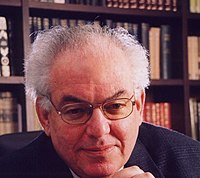
Rabbi David Hartman Z"L
In an age when religious fundamentalism is commandeering Jewish life and taking it out of the comfort zone of many many Jews who also want to live in the real world, David Hartman fought to get it back for us.  His friend, colleague and study partner Charlie Buckholtz wrote this description in The Rabbi Who hated Lies, an article in The Tablet:


"His Orthodox critics never understood that his criticism and creative reinterpretations of the tradition were not offered out of religious spite, or a desire to lead their adherents astray, but to protect Judaism and the Jewish people from them—from Orthodoxy’s corrupting distortions of the tradition, from their claims to exclusive authenticity. He knew the Orthodox leadership’s perpetual constrictions, prohibitions, and negative pronouncements left precious little room for modern Jews to find or create a meaningful Judaism for themselves. In that sense, he saw the Orthodox establishment as robbing the majority of the world’s Jews of access to their birthright.
‘I’m fighting a war,’ Hartman told me, ‘on the monopoly of certain people on truth, on the understanding of what Judaism is.’
“I’m fighting a war,” he told me, “on the monopoly of certain people on truth, on the understanding of what Judaism is.”
Ultimately, his war was over whether “authority”—whose obsessive focus among the Orthodox, particularly haredi fundamentalists he saw as a function of anxiety rather than piety—would be allowed to become the dominant Jewish religious category of the modern era. He felt tortured by the fact that the tradition had become the jurisdiction of fundamentalists, on whom it was mostly lost. He favored a more open-ended approach to religious life in which Jewish practice is treated as an open-ended field of experimentation. “I don’t want order!” I can remember him shouting. “I want vibrancy, passion, people to have a stake in it, lay claim to it, feel it’s theirs, it doesn’t belong to anybody else. There’s plenty of order in a graveyard.”"

I've long had similar thoughts that I've ranted in a very ineffectual manner to a few like-minded friends. I don't have what it takes to change the [Jewish] world or even make any waves. For that you need an intellectual powerhouse like David Hartman Z"L. I wanted, maybe even needed, to pay my respects.

I went to the shiva and it was packed. Each of the mourners I know had a circle of 10, 15, 20 people around them and they were deep in conversation. I went round to each one and, interrupting as one does, said how much I admired their father. I found a chair and sat for a couple of minutes but I wasn't really helping any so I decided to leave. I went to the son, Donniel, first...
"I'm going to go. There are so many people here and I don't really know what to do with myself."
Donniel answered with a chuckle, "yes I see that."
"Mumble mumble mumble Yerushalayim" (It's something you say in Hebrew meaning: May God comfort you among the mourners of Zion and Jerusalem - I know the words but I can never get my tongue around it so I just mumble.)

I went and mumbled again to two of the sisters, interrupting them again. On my way out I mumbled to Mrs Hartman who doesn't know me from Adam but I thought it the polite thing to do. I probably should have mumbled to the other sister and brother who I don't know but I didn't - sorry about that.

Not my most successful shiva visit but I'm glad I went. The Jewish world lost a great man this week and I, a lapsed worshiper who doesn't study or learn religious stuff and who is very flexible with the rules, I feel the loss.

Wednesday, February 13, 2013

House Of Mourning

This morning I paid a shiva call. That's how we say it for some reason. In Jewish families, when someone dies the funeral is held as soon as possible - same day if it can be arranged. There is dignity in this. The Muslims do it too. I will always remember how Dodi Al-Fayed was laid to rest while Princess Diana's body was shlepped up and down the country from place to place while a million people came out to watch and even (why oh why?) to look at the body.

Then the spouse, children and siblings (and parents if necessary - God forbid) sit at home for seven days on low chairs while anyone who knows them or the deceased pays a condolence visit. This is called shiva which means seven and also sitting.

Apparently it's an exhausting week but it serves many purposes and is a comforting process. Obviously there is the spiritual side of honouring and remembering the deceased, reciting special prayers, lighting a candle, making a symbolic rip in your clothing and wearing that item all week, and eating certain foods on returning from the funeral.

There is also the worldly side. For a week the family stays together and are surrounded by friends. There is much talking about the loved one, the family, the past, the recent past, how you feel, anything else, everything else. Talking is good. And the whole thing is so exhausting, apparently, that you don't have too much time to dwell and get too depressed. Before you know it a week has gone by that possibly could have been the hardest week to bear.

Every shiva is different. The best case scenario is a bunch of middle aged siblings celebrating their parent's long and happy life. Other shivas are  more sombre. And some are downright tragic. A friend who had to sit shiva for her father with a mother she didn't get on with, in her mother's home a continent away from any other family and friends remarked wryly, "You don't always get the shiva you wanted."

Sometimes the family imposes visiting times to give themselves a rest and space to eat. Sometimes people come late and overstay their welcome too far into the night. When my father was sitting for my 89yo grandfather, one of the great-aunts started looking purposefully at her watch as the clock struck 10. It had been a very long day, she was in her 80s herself, and she'd had enough. When that didn't deter the few die-hard talkers, she went and got her coat and hat, put them on and returned to her chair. That did it, within a minute the room was miraculously cleared.
"I'll drive you home Aunty," said my cousin.
"Not yet," she replied removing her coat, "Let's have a cup of tea first."

I meant to write about today's shiva but I don't want to add it on to the end of a post that has already rambled on for too long. I'll write about it tomorrow. I have things to say.