Showing posts with label History. Show all posts

Saturday, February 17, 2018

Orphan Trains And Potatoes

You can learn a great deal by reading children's books. Sometimes a short, light read ticks all the boxes regarding time and effort and 'bam!' you know a whole topic you previously had no idea about.

I recently borrowed these two books from the school library. The Orphan Trains by Annette R. Fry (1994, New Discovery Books, NY) and The Amazing Potato by Milton Meltzer (1992, HarperCollins, NY).

From the 1850s thousands of immigrants a week were arriving in New York City and Boston. Most of them from Ireland and Germany.

The Irish were initially escaping the results of the Potato Famine. Ireland almost solely relied on potato crops for food so a devastating blight in the 1840s led to mass starvation and emigration, mostly to America. This wave of emigration continued well after the end of the famine and into the 20th century.

The ships from Germany were carrying Europeans from all over Europe but especially Jews escaping persecution in Russia and Poland, and from the 1880s, specifically the pogroms. Later they were desperate to get out of Germany and all of mainland Europe. The Jewish emigration continued until after WW2.

Conditions in the city were terrible. Many families sharing apartments in already crowded tenements with no bathrooms, only a few toilets for the whole building, and shared cooking facilities. So many unskilled (for the city where farmers were not needed) people looking for jobs, rent to pay and food to buy, so much disease from overcrowding in unsanitary conditions, and no family planning. All this led to hundreds of children abandoned, living in the streets, or left in orphanages that were bursting at the seams. Some of them were orphans but many were from families who could no longer cope with another mouth to feed, single parents who had to work to survive, or children who ran away from alcoholic and abusive parents drowning in their own misery.

In 1852 the Reverend Charles Loring Brace saw the need to save the children if they were to have any chance of a good life. He believed that families were the answer, not institutions. The result was the Children's Aid Society of New York, founded in 1853. The society's innovative solution was to send children westward into the American interior where families could adopt them. Families who needed boys to help on the homesteads and girls to help in the house. And couples who just wanted a child, or another child.

Of course the book I read was written for children so it skipped over the fact that many of the children were treated as slaves and abused in their new homes. And many of them resented the fact that they had been sent far away when they already had families in New York. Many of them ran away from their new homes and did not end up as the upright adults they were 'supposed' to have been.

Fry relates the success stories of children loved and educated. Children who grew up to be lawyers, doctors, clergymen, mayors and politicians. They inherited property, they became parents and grandparent across America.

By the 1920s the Western States had big cities of their own with their own poverty and orphans to care for. They didn't want more children dumped on them from the East. Homesteading was no longer the way to make it rich and most of the land had already been claimed. People were more likely to be living in towns and cities where extra children weren't needed so much.

The last orphan train left New York in 1929. Over 200,000 children had been relocated on orphan trains and baby trains over 76 years. And yet, until the 1970s, hardly anyone had heard of this movement. People were secretive, ashamed of their lowly past or frightened of being stigmatized perhaps. Many of the Baby Train children were never even told that they had been adopted.

Some rough mental arithmetic suggests that by 1976, when everything changed, there were over a million Americans whose parents or grandparents were orphan train children and most of them knew nothing about it.

What happened in 1976? I found this fascinating as I remember the event well. In 1976 we all watched Roots on television. Alex Haley traced his family back 10 generations to a black tribesman, Kunta Kinte, who was kidnapped in West Africa and sold as a slave in America. Suddenly one's ancestry was something to be proud of, no matter how lowly. It was the beginning of popular interest in genealogy.

The last orphans now in their 50s to 80s started trying to find out who they really were. If they had blood relatives. Were they Irish or Jewish? And their children suddenly found out that their grandparents were their adoptive grandparents. The story was out.

The Amazing Potato wasn't so sensational except for the tragic chapters about the Potato Famine. It was interesting to make the connection between the two books. All history is connected after all.

One fact I loved in the potato book is that the potato was brought to Europe by the Spanish conquistadors who found people eating potatoes in Peru. They were after gold which they stole in great quantities. The potatoes were just what to eat on the journey home. The potato industry was worth $100 billion a year in 1992. (Almost 30 years later this figure has probably doubled or even tripled.) LOL, they should have left some of the gold and invested in more potatoes.


Friday, January 16, 2015

Why The Downton Diet Won't Work

I have just watched all five seasons of Downton Abbey in about two weeks - I usually made it to bed before 2 am (just) except for one memorable night morning when having watched a whole season in one sitting, I crawled under the covers at 4.30 am.

Being obsessed with food and diets, I came up with the brilliant idea of a Downton Abbey Diet. I googled Downton Diet to check that it'd not already been done and got 27,700,000 results in 0.45 seconds. Oh well.

The thought is an obvious one of course. Here are a family of stick thin women who never go to the gym, don't do pilates or yoga, do not jog (heaven forfend) and eat without ever considering calories, carbs, fat, or any other nutritional science. They eat three meals a day and afternoon tea with cake.

On the surface you could make a good argument for the Downton Diet (other than the catchy alliteration). I thought about it a lot and made a study of what and how they actually ate. Of course I'm only talking about the family upstairs. Downstairs they can eat whatever they want as they are engaged in physical labour for upwards of 14 hours a day and running between four storeys to do it. Upstairs, one writer has already pointed out that though they do walk a lot, on the other hand they don't even lift their own hairbrushes to do their hair.

It seemed to be done by eating meals of basic ingredients cooked from scratch, no foods with added chemicals or trans-fats, small portions, eating slowly, no seconds and no eating between meals. I noticed that the women drank a cup of tea at teatime but never took a slice of cake. Every meal was an occasion. Marielle Guiliano says to do that in French Women but she doesn't go so far as to recommend dressing for dinner every night.

I was all set to write the book me. So to extend my research I did a bit  more googling around the subject. Turns out things weren't all Downton Abbey in the 1900-1920s. In fact far from it. So here are the reasons The Downton Diet has been scrapped.

1. The Crawley women are all actresses in 2015, not real women from the 1920s. I know this will come as a shock (it did to me) but they are probably all working out for two hours a day and doing the Atkins/Juicing/5:2 diet.

2. I looked at pictures of real women from that era and whilst none of them is obese (no fast food, processed calorie laden snacks, or take-aways) they are all shapes and sizes. They don't look as skinny as the Downton ladies that's for sure. Some are less curvy and some more so but it looks like no one cared or even gave it a second thought. And in fact men preferred the curvier figure that suggested a life of ease rather than one of a starving skivvy.

3. After The London Season Edwardian society departed for the The Season Abroad, attending spas in Germany and Austria, or Switzerland. There they would be put on a strict regime of diet and exercise. After a month they would return home with their stomachs settled and their weight down. Some people repeated the spa experience again after The Christmas Season. They had to do this every year as, in fact, they lived a life of gluttony. All they did was eat and socialize. Pre-breakfast, sit-down breakfast, mid-morning snack, luncheon, afternoon tea, a fuller tea for when dinner would be late, a multi-course dinner, a late night supper, and nibbles placed in bedrooms in case they were peckish during the night.

4. The cook worked full time in the kitchen. She had no other duties. The raw ingredients were delivered so she didn't even have to go shopping. They do say you have to make the time for a diet but this arrangement might be a bit excessive for anyone with a life. Having said this, Sarah Ferguson did take a few months out to do a full-time diet in Switzerland with a private cook and diet coach. Although she came back ready to teach us all how we too can lose weight like her, we all understood that we may be able to lose weight but not 'like her.'

5. Even the raw basic foods we buy now are not as pure and basic as the food was 100 years ago. Our meat and dairy is full of antibiotics and hormones, our eggs might be too, our fruit and veg is genetically modified and sprayed with dangerous pesticides, much of it comes frozen and vacuum packed from half way around the world, and salt and sugar is added to anything you didn't pick/kill yourself. I'm exaggerating but only because the food industry is so large, powerful, convoluted, and secretive that no one really knows the truth.

So there you have it. The rise and fall of The Downton Diet. Anyone fancy some cabbage soup?


Monday, February 10, 2014

Why I Read Historical Novels

The Bible Lands Museum, Jerusalem
Foreword

About 16 years ago they opened the Bible Lands Museum in Jerusalem. A big, purpose built, modern building, dedicated to artifacts and knowledge about life in the Near East in Biblical Times. I had absolutely no interest in visiting it whatsoever.

One Monday in the late afternoon, I took myself off to the Israel Museum which is next door to the Bible Lands. The Israel Museum has art and I love art. What I didn't know was that it's closed on Monday afternoons.

It was pre-mobile phones and by the time I'd walked to the gate, realised it was locked, and walked back to the car park, my taxi had left. I decided to not waste the journey completely and so I wandered, half-heartedly, over to the Bible Lands Museum.

This museum was closing in 90 minutes. Perfect. I expected to be out of there well within the hour.

Reader, I spent the entire 90 minutes in the first room and still had not finished when the closing bell sounded. I usually skim the labels in museums. On this occasion I found myself reading every word mesmerised by all of it. I'd expected Bible stories and parchments. The reality was everyday items depicting an entire way of life in biblical times. There are Bible stories and parchments later but I didn't get that far.

I had to reluctantly leave at closing time but vowed to return very soon. Since then I've been back twice. Once for a music lecture and once for a Bar Mitzva party. Both those events were in the evening and neither had any connection to the museum itself.

Chapter 1

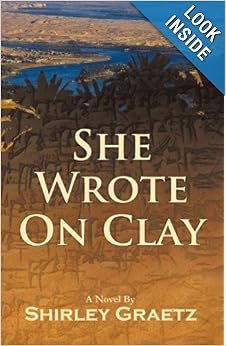
She Wrote On Clay is a book I read last month. You can't look inside, I took the image url from Amazon.com. Despite the link, this is not a sponsored post. I read She Wrote On Clay for three reasons:

1. It's an historical romance set in Ancient Babylon. How could I resist a chance to get some insight into life in Ancient Babylon which isn't too distant from where I'm living?  (In kms I mean, not time.)

2. The author, Shirley Graetz, is a friend of mine. A local Mum whom I met a few years ago in the park and now regularly chat with outside the school gates at the end of the day.

3. It's a romance but it's also about a rare occurrence of feminism in ancient times. Litani, the heroine, is a female scribe in a male dominated profession. Sometimes we think we invented feminists and feminism but not so.

I loved the book and am eagerly awaiting the sequel as I absolutely need to grow old with Litani, the feisty, feminist, heroine.

Chapter 2

A few days ago I was talking on the phone with another friend who is a tour guide. She mentioned that a fellow guide was giving her a tour of the Bible Lands Museum on Monday morning. I remembered how much I had loved that museum so I made the right noises and she invited me to join them.

(I should have a photo here of the three of us at the museum, but I don't.)

I saw the clay tablets Litani had written on. I saw the perfume bottles and the amulets. I saw the ornate boxes they used to store their possessions, the writing tools, the buildings they lived in (well models of them), the cities, the kitchen utensils they used, seals, jewellery...

If I was fascinated last time, this time with a bit of insight into the background and lifestyles of the people, I was positively spellbound.

I'm done with school and studying for studying's sake. I further my knowledge with YouTube, TV dramas, short articles shared by friends on facebook, and reading for pleasure. Not all my book choices are novels. There are many highly enjoyable popular history/sociology/philosophy books written for the lay person. I wouldn't bother with anything heavy. Historical novels have given me more over the past 30 years than years of history lessons in school. No school outing to any museum ever thrilled me as much as seeing She Wrote On Clay come to life in the Bible Lands Museum today.